


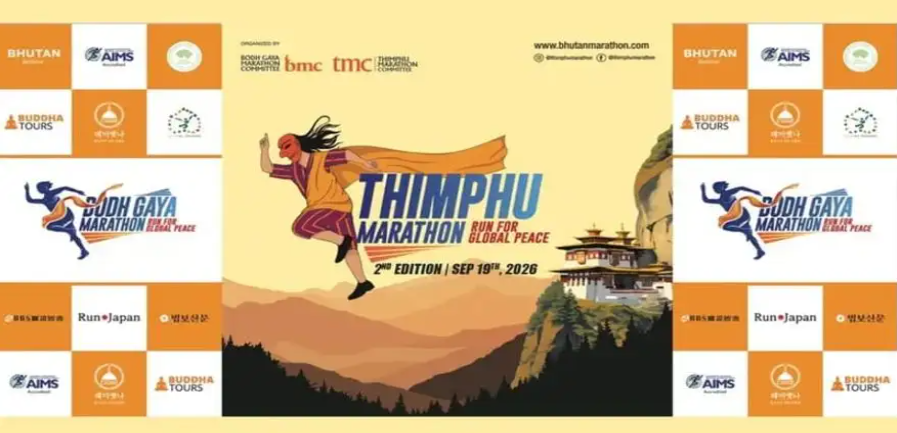
Thimphu Marathon 2026 – 2nd Edition
Event On - 19th Sep 2026
Description
EVENT INFORMATION
Thimphu Marathon – Run for Global Peace – 2nd Edition
Thimphu, Bhutan – 19 September 2026
Set against the breathtaking Himalayan landscapes, the Thimphu Marathon 2026 – 2nd Edition is more than just a race. It is a global celebration of resilience, unity, and environmental consciousness, bringing together participants from across the world to champion peace, well-being, and sustainability.
This extraordinary event invites runners to embark on a transformative journey through Bhutan’s serene valleys, riversides, and culturally rich landscapes, while raising awareness about pressing global challenges such as climate change and environmental preservation.
The marathon will be spiritually blessed, honoring Bhutanese traditions and values, and emphasizing mindfulness, harmony, and holistic well-being. Participants will also experience Bhutan’s innovative initiatives, including the Gelephu Mindfulness City, reflecting the nation’s vision for sustainable and mindful living.
Why This Marathon is Special
Global Unity: Run alongside participants from around the world, promoting solidarity, peace, and cross-cultural understanding.
Environmental Advocacy: Support Bhutan’s eco-conscious initiatives and contribute to a greener, sustainable future.
Health & Mindfulness: Promote physical fitness, mental wellness, and mindfulness through this immersive experience.
Cultural Immersion: Explore Bhutan’s unique heritage, vibrant traditions, and stunning natural scenery while participating in the race.
Be a part of this landmark initiative, create lifelong memories, and contribute to a movement for global peace and sustainability.
Event Date: 19 September 2026
Venue: Chang Lam SE, Thimphu, Bhutan
Distance: 42.195 KM, 21.097 KM, 10 KM, 5 KM & 2.5 KM Fun Run
Register Now: https://sportifi.in/event/tm-2026
Age Categories:
Marathon & Half Ma rathon (Age categories)
18 to 34 Years (3 Male & Female)
35 to 44 Years (3 Male & Female)
45 to 54 Years (3 Male & Female)
55 to 64 Years (3 Male & Female)
65+ Years (3 Male & Female)
10 KM (No Age Categories)
Top 3 Males and 3 Females
5 KM - Green Run (No prizes & No Age Categories)
The top 3 males and 3 females in Marathon and Half Marathon will be rewarded with cash prizes
Note:- There are no cash prizes in age categories.
Only trophies will given to age categories winners with Certificates
Important Information for Thimphu Marathon Participants
1. Customized BIBs: To receive a customized BIB with your name, please make sure to register at least 15 days before the event date.
2. Non-Transferable Registration:
Registrations with discounted rates are non-transferable. The registered participants must use the BIB assigned to them.
3. BIB Expo:
The BIB Expo will take place one day prior to the event at the designated venue. There will be no BIB Expo on the event day.
4. BIB Collection on Behalf of Others:
If someone is collecting BIBs on behalf of other participants, they must present a consent letter from the registered participants in order to receive the BIB.
5. No On-Spot Registration:
On-spot registrations will not be available. Participants must register in advance to secure their participation.
6. BIB Exchange:
Participants are not allowed to exchange their timing BIBs with others. Each BIB is unique and should only be used by the assigned participant. Any participant found wearing another participant's BIB will be disqualified.
7. Proper Placement of BIB:
Participants must wear their BIB on their chest, ensuring it is visible. Wearing the BIB on the back will result in disqualification from the winner's list.
8. Email Updates:
All event-related updates will be shared via the registered email address.
Facilities provided during the event
1. Baggage Counter:
There will be a baggage counter available at the venue for participants to store their belongings securely.
2. Medical Support:
Ambulances will be stationed along the route, and a dedicated medical team will be present at the venue and at multiple points along the route.
3. Hydration Points:
Hydration points will be available at regular intervals of 1-2.5 kilometers to provide participants with Hydration support
4. Washroom Facilities:
Washrooms will be accessible at the start/finish area and along the route for participants' convenience.
5. Timing System:
Timing systems will be in place at the start/finish line, 5 kilometers, 10.5 kilometers, and 21 kilometers for timed runners participating in the respective categories.
6. Route Marking:
The route will be clearly marked with arrows and other indicators to guide participants along the correct path during the half marathon.
7. Pre-Event Zumba and Post-Run Cool down:
Participants can enjoy a pre-event Zumba session to warm up and a post-run cool down session to cool down their bodies.
8. Route Marshals and Volunteers:
Route marshals will be stationed at various points along the route to guide participants, and volunteers will be present at hydration points and other locations to provide assistance.
9. Start and Finish Line:
The start and finish lines will be clearly marked and well-organized, providing participants with a seamless race experience.
10. BIB with Timing Chips:
Participants in the timed categories (42.195 km, 21.097 km, and 10K) will be provided with timing chips to accurately record their race times.
11. Medical Aid Stations:
Along the route, there will be dedicated medical aid stations equipped with medical professionals and supplies to attend to any participant in need of assistance.
12. Energy Stations:
In addition to hydration points, energy stations will be strategically placed along the route, offering participants energy gels, fruits, or other nutritional supplements to support their performance during the race.
13. Route Entertainment:
To keep the spirit high and energize participants, there may be music, Dhole, or cheering squads at various points along the route.
14. Photography and Videography:
Professional photographers and videographers may be stationed at key locations to capture memorable moments of the participants' journey. These visuals will be made available for participants to relive their marathon experience.
15. Finisher Medals and Certificates:
Participants who successfully complete the race will be awarded finisher medals and certificates as a token of their achievement. These mementos can be cherished as a reminder of their participation in the Bodhgaya Marathon.
16. Post-Race Refreshments:
After crossing the finish line, participants will have access to post-race refreshments.
17. Event Merchandise:
Official Bodhgaya Marathon merchandise, such as t-shirts, caps, or wristbands, may be available for purchase as souvenirs or memorabilia of the event.
18. Transportation and Parking:
Information regarding parking facilities and transportation arrangements to and from the venue will be communicated to participants in advance to ensure a smooth arrival and departure process.
19. Lost and Found:
A dedicated Lost and Found area will be set up at the event venue to assist participants in retrieving any lost items during the marathon.
For Any Queries call us at +975 17118130
Email us at info@bhutanmarathon.com
About Bhutan:-
Bhutan, often referred to as the "Land of the Thunder Dragon," is a small, landlocked country in the Eastern Himalayas, known for its rich cultural heritage, stunning landscapes, and commitment to Gross National Happiness (GNH).
Geography and Demographics
Location: Bhutan is bordered by China to the north and India to the south, east, and west.
Population: As of recent estimates, Bhutan's population is around 750,000 people.
Capital: Thimphu is the largest city and the capital of Bhutan.
Political System
Government: Bhutan is a constitutional monarchy, with a King who serves as the head of state and an elected Prime Minister as the head of government. The country's political system emphasizes the principles of GNH, focusing on the holistic well-being of its citizens.
Economy
-Key Industries: Bhutan's economy is predominantly based on agriculture, hydropower, and tourism.
Agriculture: The majority of the population engages in subsistence farming, cultivating crops such as rice, maize, and potatoes.
Hydropower: Bhutan's mountainous terrain and abundant rivers provide significant potential for hydropower, which is a major source of revenue through exports to neighboring countries.
Tourism: With its unique culture, pristine environment, and well-preserved traditions, Bhutan attracts tourists seeking an authentic and serene experience. The government regulates tourism to ensure sustainable development and environmental preservation.
Culture and Traditions
Cultural Heritage: Bhutan is renowned for its vibrant cultural heritage, which includes traditional arts, festivals, and architecture. The country's policy of maintaining cultural authenticity is evident in its dress code, dzong architecture, and religious practices.
Festival: Bhutanese festivals, or "Tsechus," are important cultural events that feature masked dances, traditional music, and communal celebrations. These festivals are held throughout the year in various monasteries and dzongs.
Environment and Conservation
Environmental Protection Bhutan is a global leader in environmental conservation, with over 70% of its land covered by forests and a commitment to maintaining carbon neutrality. The country's constitution mandates that at least 60% of its land area remains under forest cover for all future generations.
Gross National Happiness
Philosophy: Bhutan's unique development philosophy, Gross National Happiness (GNH), prioritizes the well-being of its citizens over economic growth. GNH is based on four pillars: sustainable development, cultural preservation, environmental conservation, and good governance.
Bhutan's dedication to preserving its cultural heritage, commitment to environmental conservation, and pursuit of holistic well-being make it a unique and inspiring nation on the global stage.
Bhutan History
Bhutan, the "Land of the Thunder Dragon," has a history that's as majestic as its landscapes. Here's a more detailed look into its rich and fascinating past:
Ancient and Medieval Periods
Early Settlements: Archaeological evidence suggests that Bhutan was inhabited as early as 2000 BC. The early inhabitants practiced animism and shamanism, with some influence from Tibetan Bon practices.
Buddhist Influence: In the 8th century, Guru Padmasambhava, also known as Guru Rinpoche, visited Bhutan. He is credited with bringing Tantric Buddhism to the region, which laid the foundation for Bhutan's cultural and spiritual heritage.
Unification and Consolidation
Zhabdrung Ngawang Namgyal: In the early 17th century, Zhabdrung Ngawang Namgyal, a Tibetan lama, fled to Bhutan and unified the country. He established the dual system of governance, combining secular and religious authorities, and constructed numerous dzongs (fortress-monasteries) that became centers of administration and religion.
Civil Strife: After the death of Zhabdrung Ngawang Namgyal in 1651, Bhutan experienced a period of internal conflict and power struggles among regional chieftains and religious factions. Despite this, the country remained unified under the overarching framework he had established.
19th and Early 20th Century
British Encounters: In the 19th century, Bhutan faced external threats from British India. Conflicts such as the Duar War (1864-1865) led to the signing of the Treaty of Sinchula, which ceded some Bhutanese territories to the British.
Establishment of the Monarch: In 1907, Ugyen Wangchuck was unanimously elected as the first King of Bhutan, establishing the hereditary monarchy. This marked the beginning of modern Bhutanese governance and stability.
Modernization and Development
Independence and International Relations: Bhutan maintained its independence through careful diplomacy. In 1949, Bhutan signed a treaty with newly independent India, ensuring mutual respect for each other's sovereignty.
Joining the United Nations: Bhutan became a member of the United Nations in 1971, further integrating into the global community.
Constitutional Monarchy: In 2008, under the leadership of King Jigme Khesar Namgyel Wangchuck, Bhutan transitioned to a constitutional monarchy. This shift marked a significant milestone in the country's political evolution, introducing democratic elements while preserving the monarchy.
Cultural Preservation and Gross National Happiness
Cultural Heritag: Bhutan has maintained a strong emphasis on preserving its cultural heritage. Traditional arts, crafts, festivals, and dress are integral parts of daily life. The government actively promotes and protects these cultural practices.
Gross National Happiness (GNH): Bhutan's development philosophy of Gross National Happiness, introduced by the Fourth King, Jigme Singye Wangchuck, focuses on holistic well-being rather than just economic growth. GNH is based on four pillars: sustainable development, cultural preservation, environmental conservation, and good governance.
Environmental Conservation
Natural Environment: Bhutan is known for its commitment to environmental conservation. The constitution mandates that at least 60% of the country must remain forested. Bhutan is also a carbon-negative country, absorbing more carbon dioxide than it emits.
Bhutan's history is a testament to its resilience, cultural richness, and innovative approach to governance and development. The country continues to inspire the world with its unique blend of tradition and modernity.
Sure! Here’s a brief, professional, and uniquely crafted summary of some of Bhutan's Highlight Places:
Taktsang Monastery (Tiger’s Nest):
Perched on the edge of a cliff, 900 meters above the Paro Valley, Taktsang Monastery is a spiritual marvel and a breathtaking sight. This sacred site, where Guru Rinpoche meditated, epitomizes Bhutan's blend of natural beauty and spiritual heritage.
Punakha Dzong:
Located at the confluence of the Pho Chhu and Mo Chhu rivers, Punakha Dzong is a majestic fortress and monastery. It is renowned for its stunning architecture, serene ambiance, and historical significance as the former seat of Bhutan’s government.
Thimphu:
The vibrant capital city, Thimphu, seamlessly merges tradition with modernity. Highlights include the majestic Buddha Dordenma statue, the National Memorial Chorten, and the bustling markets that offer a glimpse into Bhutanese culture and daily life.
Phobjikha Valley:
A glacial valley and a conservation area, Phobjikha is a haven for nature lovers and bird watchers. It is home to the endangered black-necked cranes, and its serene landscapes provide an ideal setting for treks and retreats.
Dochula Pass:
At an elevation of 3,100 meters, Dochula Pass offers panoramic views of the Himalayas. The pass is adorned with 108 chortens (stupas) and vibrant prayer flags, making it a picturesque and spiritually enriching stop.
Haa Valley:
One of Bhutan's most pristine and least-visited areas, Haa Valley is a hidden gem. Its unspoiled landscapes, traditional villages, and ancient temples make it a perfect destination for those seeking tranquility and authenticity.
These highlight places encapsulate the essence of Bhutan’s natural splendor, rich cultural heritage, and spiritual depth. Each location offers a unique experience, inviting visitors to immerse themselves in the timeless beauty and profound serenity of this Himalayan kingdom.
Partners & Associates

All Reviews
Be the first to review Add Review


